
You already know how few reasonable funding options if your credit score is below 600. Most lenders will either reject you outright or offer you terms that are so bad they are not worth taking. One of the most important choices you will make right now is between secured and unsecured finance.
It is also very easy to find good business loans for bad credit once you know which type to apply for. For applicants in this credit bracket, secured loans have an average approval rate of 65%, while unsecured loans sit at just 25%. Your credit score will affect the exact terms you get.
How Secured Business Loans Work?
Most people with bad credit will hear about secured loans first. They work on a very simple principle that removes risk for the lender. They base it on something tangible instead of making a decision based on their past mistakes with money.
You will be asked to put forward an asset as security for the loan. This can be property, equipment, vehicles, inventory or almost any other tangible business asset. The lenders will usually offer between 60 and 80% of the official value of that asset. It is within the legal rights of the lender to sell the asset and recover their funds in case you are unable to make repayments.
You are able to borrow between £5,000 and £1,00,000 and above with terms of 1 year and above 25 years. The approval usually takes between 2 and 6 weeks.
There are a lot of small details about secured loans:
● You retain full and unrestricted use of the asset for the entire length of the loan
● Most lenders will allow you to settle the loan early with no additional penalty fees
● The asset does not need to be completely paid off to be used as security
● You can combine multiple smaller assets to reach the total value you require
This is the reason that almost all direct loan lenders for bad credit will prioritise secured loan products above all others. They are able to offer approvals to people who would be rejected for every other form of business finance. They will rarely turn down an application as long as the asset value stacks up. You will not be asked to explain past defaults or county court judgments in most cases.
How Unsecured Business Loans Work?
Unsecured loans work the exact opposite way from secured loans. There is no asset tied to the agreement, so the lender has no automatic way to get their money back if you cannot keep up with repayments.
The lenders will make their decision based on your credit history and the recent performance of your business. The unsecured loan will require you to sign a personal guarantee. This renders you as an individual liable for the debt in case the business is unable to pay.
The amount you can borrow is normally between £1,000 and £50,000, with terms of 3 months to a maximum of 5 years. The approval can be as fast as 24 hours. They have higher minimum credit requirements than secured loans.
Again, there are fewer details:
● You will never be asked to arrange or pay for any kind of asset valuation
● Most lenders will only ask for 3 months of bank statements to make a decision
● Fixed monthly repayments are standard across every major provider
● You will never be asked to prove what you spend the loan money on
| Secured vs Unsecured Loans for Poor Credit | ||
| Feature | Secured Loans | Unsecured Loans |
| Collateral Required | Yes (property, equipment, vehicles) | No |
| Typical Interest Rate | 6-20% APR | 15-50% APR |
| Loan Amount | £5,000 – £500,000+ | £1,000 – £50,000 |
| Approval Time | 2-6 weeks | 24 hours – 1 week |
| Minimum Credit Score | 400+ | 550+ |
| Repayment Terms | 1-25 years | 3 months – 5 years |
| Risk Level | High (asset loss) | Medium (personal guarantee) |
| Approval Rate (Poor Credit) | 65% | 25% |
Eligibility Requirements for Each Loan Type
You can break down exactly what you will need to qualify for each one. They are the hard minimums that almost every provider will stick to, even if they advertise guaranteed approvals.
Secured Loan Eligibility
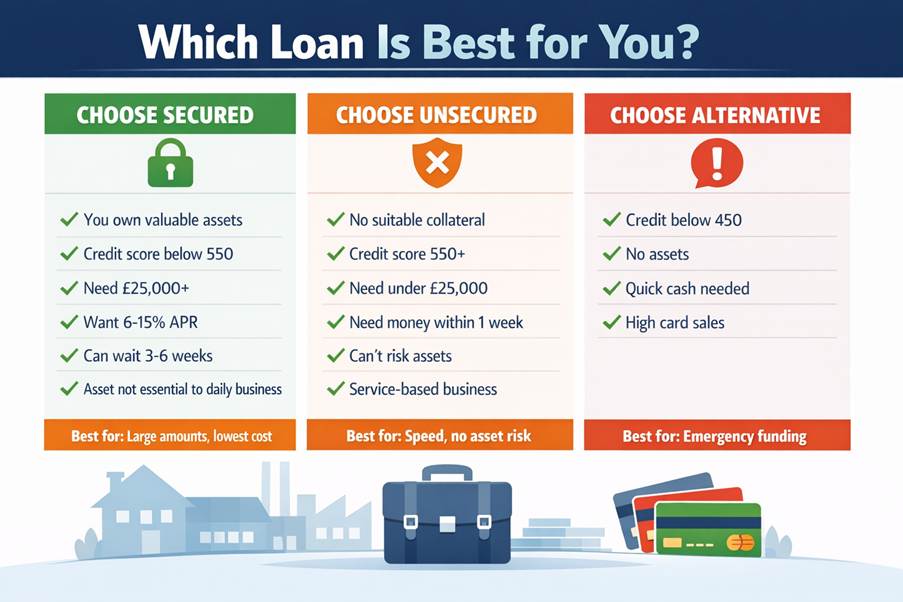
You will need a credit score of 400 or above. Your business will need to have been trading for at least 6 months. You will need a minimum annual turnover of £10,000. And most importantly, you will need an asset that is worth more than the total amount you want to borrow.
Unsecured Loan Eligibility
The minimum requirements for an unsecured loan are higher. You will need a credit score of 550 or above as an absolute minimum. Most lenders will prefer your business to have been trading for at least 12 months. You will need a minimum annual turnover of £25,000. You need to show consistent, regular cash flow coming into the business every month.
How Much Can You Borrow with Poor Credit?
The maximum amount you can get approved for is lower. This is one of the biggest differences between the two loan types, and often the deciding factor for most people.
Secured Loan Maximums
Exactly how much you can borrow with a secured loan depends on the asset you offer. You will be offered up to 70% of the value of the commercial or residential property you use. You can borrow between £5,000 and £250,000 if you use business equipment. You can borrow between £2,000 and £100,000 if you use vehicles or vans.
Unsecured Loan Maximums
Your credit score will determine how much you can borrow without any security. Assuming a credit score between 400 and 500, you will be able to borrow up to the extreme limit of between £1,000 and £10,000. You will be able to borrow between £5,000 and £25,000 if your score is between 500 and 600.
How to Make Your Loan Application Stronger?
There are small changes you can make to your application that will double your chance of approval.
● Step 1: Gather 2 to 3 years’ worth of full accounts. The lenders care far more about consistency than perfect numbers.
● Step 2: Show within 3 months of steadily increasing revenue. One month of sheer performance is inferior to one small continuous increasing trend.
● Step 3: Write a one-page outline of what you will use the money for and how it will increase your turnover. You do not need a long formal business plan.
● Step 4: Pay down any small outstanding default balances if you can. Even clearing a £200 default will make a very big difference to your application.
● Step 5: Add a guarantor with good credit if you have one available. This will only ever be required if your credit score is below 450.
● Step 6: Offer a 20 to 30% deposit if you are able. This will drop your interest rate and get you approved much faster.
● Step 7: Mention any relevant industry experience you have.
● Step 8: Check your credit file for any mistakes. You can have incorrect defaults removed in as little as 14 days.
Conclusion
There is no universal right answer that works for every business owner. A secured loan will almost always be the better choice if you have an asset you can put forward as security. This gives you far higher approval odds and much lower monthly repayments.
You only need to borrow a small amount for less than a year if you do not have suitable assets. You do not submit lots of applications at the same time, as this will drop your credit score. Once you have decided which type fits your situation, put together a simple application, and you will get a decision much faster than you might expect.
Frequently Asked Questions (FAQs)
Can I get a secured loan without a personal guarantee?
Yes, but it depends on the lender’s risk assessment of your business.
How long does it take to get a secured loan?
They often take longer than unsecured loans due to valuation and legal requirements, often several weeks.
Do unsecured loans appear on my credit file?
Yes, both types of loans are recorded on credit files and impact credit scores.
What if I cannot repay a secured loan?
Lenders can sell the assets used as security to reclaim the debt.
What is the minimum turnover for a UK loan?
This varies by lender, but many providers require at least 1–2 years of trading history and a minimum annual turnover.
Are secured loans always better?
Not necessarily. While they are cheaper, they take longer and put valuable assets at risk.

Anna Johnson has more than 11 years of experience in direct lending industry of the UK. She is the Senior Content Editor at 24cashflow where she is leading a large team of loan experts. During her career, she has helped the loan aspirants to use the particular loans in the best way and improve their financial lives and status.
Anna Johnson is known for her in-depth research of the UK loan marketplace, as she has worked with many major lending firms in her career. During her educational phase, she has done a research on ‘Finance Fundamentals for Growing Business’.