Debts should be treated as early as possible, or else they will accumulate more interest. Debt consolidation and debt management are two approaches meant to address pending cash issues. Before implementing any of these steps, make sure that you have chosen the right path.
The decision should not be random and should be based on proper analysis. Your financial condition should be evaluated first. This is because you might have other issues going on side-by-side.
For example, your credit scores might not seem perfect while you are managing debts. In that case, you need to take the route carefully, as you will have to treat credit score issues at the same time. Depending on your situation, getting debt consolidation loans in the UK with bad credit might make sense.
Here, at a glance, you can check out the potential differences between these two approaches.
| Feature | Debt consolidation | Debt management |
| New borrowing | Possible | Not possible |
| Monthly payments | It will be fixed | It will be flexible based on affordability |
| Interest rates | Might be reduced | Might be frozen or reduced |
| Effect on credit scores | If managed well, it can be neutral to positive | It might turn out to be negative initially |
| Repayment | Repay the principal with interest | Repay the full amount that might get reduced at times |
Keep exploring this blog to get a deeper understanding of how debt consolidation differs from debt management and which one is better for you.
Choose between debt consolidation and debt management
The best option is relative and depends on certain factors and your financial condition. To be able to determine the right approach, you must carefully flip through the pros and cons of each option. Then, you will know which option will fit your situation conveniently.
These are two popular ways of tackling debt problems. Dig deeper to fetch more information and decide.
What is debt consolidation?
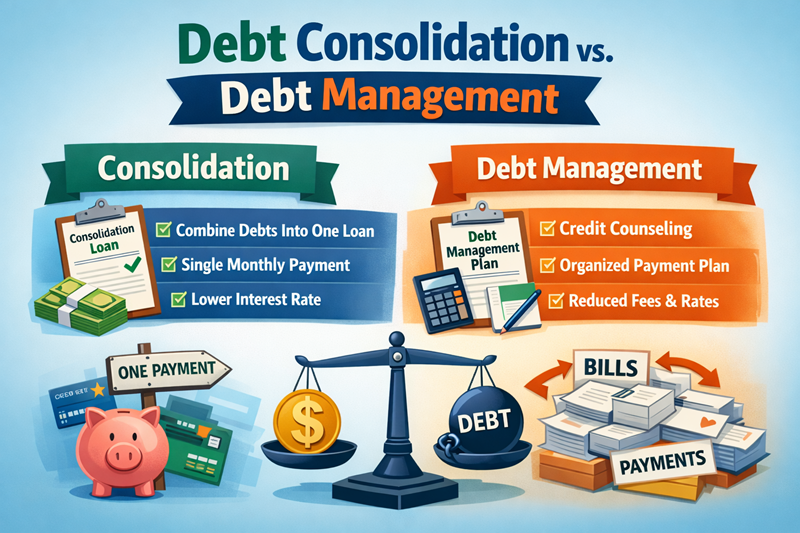
This is a process of combining existing debts and paying them off together using a single loan. This means that you do not have to attend to each debt individually. All the due payments will be clubbed together and disbursed with the help of a loan.
With this approach, you can start with a new loan agreement with new rates and terms of repayment. Here, you will be dealing with one lender instead of multiple creditors. You will have to work with a single repayment schedule.
What is a debt management plan?
This is like an informal agreement that will be operational between you and your creditors. The main purpose of it is to allow eventual payment of debts over time at affordable rates. This plan has been arranged by a debt advice provider.
With this option, you can utilise your negotiation skills to lower rates of interest. Here also, debts will be consolidated, but via credit counselling agencies.
Which option can help you save more money?
A comparison should be drawn based on a few factors to understand which option is best and for what reasons.
• When cost is the biggest concern
Interest rates are the prime element responsible for increasing or decreasing the cost. If you are able to grab a lower APR with debt consolidation, you can save more money than the combined interest you were paying.
However, if you extend the repayment duration too much, you will not be able to make this much of a saving. On the flip side, with a debt management plan, you can take advantage of interest getting frozen for the time being.
This means that you will not have to pay penalties for a few months. If you observe closely, DMP can help you stash more money, but repayment can stretch longer.
• Repayment duration
Debt consolidation will last for a few years, up to 7 years. You will have a specific tenure to focus on, within which loan payments should be covered. In contrast, debt management might stretch longer as it varies depending on your affordability.
A longer debt management plan will reduce the burden of monthly payments. However, the overall payment process might not be appealing; it will proceed slowly. You need to set your priority, which could be either total cost or affordability.
When you want to reduce the total cost, consolidation should be the right approach. When affordability is your concern, management should be your right approach.
• Credit score impact
Pending payments will have a negative impact on your credit scores. While paying down debts, you must validate which approach can help your credit scores stabilise. Then, you will be able to achieve two goals at the same time.
By making payments consistently, you can improve your credit scores. This is easy to achieve through debt consolidation. With a debt management plan, you will have to bear with a lowering of scores initially. This is because you will be focusing on smaller payments in the beginning.
What are the pros and cons of both approaches?
It is a good idea to go through the benefits and setbacks so that you can make a fair decision.
Pros of debt consolidation
• Simple financial system
• Monthly payments are lowered
• Practical repayment plan
Cons of debt consolidation
• Might require good scores
• Might repay more in total
• Might end up borrowing again and again
Pros of debt management
• No requirement for borrowing
• Flexible and affordable
• Interest might not increase
Cons of debt management
• Repayment period might be longer
• Affect credit history
• Not legally responsible for repayment
If future borrowing is essential for you, debt consolidation is the right approach.
The bottom line
It might happen that these two approaches do not seem to be a suitable choice. You can consider exploring alternatives like loans for bad credit people with no guarantor claim. Assess your financial situation and the debts you are handling before choosing any financing option.
The above funding solution is appropriate for someone with poor credit scores. This loan option does not compel them to produce a guarantor, which is usually required when credit scores are not perfect.
Here, your main focus might be to pay off bills that are accumulating more interest. The possibility of getting approval for these loans will largely depend on your affordability.
Frequently Asked Questions (FAQs)
Can I use both debt management and consolidation together?
In some situations, people may choose to use both strategies sequentially instead of simultaneously. For instance, they have the option to consolidate some debts and manage others through a plan. To avoid confusion and additional costs, this approach necessitates careful financial planning.
How long does a debt management plan usually last?
Debt management plans usually last between three to five years, depending on your total debt and monthly repayment capacity. The duration could fluctuate if your financial status changes or if creditors agree to different repayment terms.
Is debt consolidation risky?
Debt consolidation is risky if it encourages additional borrowing or spending. If you use assets like your home as collateral for the loan, you run the risk of losing them if you don’t make repayments. In order to avoid worsening your situation, it’s important to have proper budgeting and discipline.
Are there fees involved in debt management in the UK?
There are debt management providers who charge fees, while others, particularly charities, provide free services. It’s crucial to examine the terms carefully, as fees can decrease the amount you pay towards your debts and extend the repayment period.
Which option offers better long-term financial outcomes?
The better option depends on individual circumstances. By managing debt, financial pressure can be reduced without the need for new borrowing, while consolidation can simplify payments and lower interest. To achieve long-term success, it is crucial to make consistent repayments, budget, and avoid additional debt.

Anna Johnson has more than 11 years of experience in direct lending industry of the UK. She is the Senior Content Editor at 24cashflow where she is leading a large team of loan experts. During her career, she has helped the loan aspirants to use the particular loans in the best way and improve their financial lives and status.
Anna Johnson is known for her in-depth research of the UK loan marketplace, as she has worked with many major lending firms in her career. During her educational phase, she has done a research on ‘Finance Fundamentals for Growing Business’.